
Most car owners pick a repair shop based on location or price. But here’s what that approach misses: the role of mechanic shop certification is what actually separates a shop that fixes your car right the first time from one that sends you back with the same problem a week later. Certifications in the auto repair world fall under a broader concept called mechanic shop accreditation, a system of credentials that verifies technician competency, shop-level quality controls, and in some states, legal eligibility to perform specific services. This article breaks down what those certifications actually mean for you.
Table of Contents
- Key takeaways
- What mechanic shop certification really means
- Why certifications matter to you as a car owner
- How to verify a shop’s certifications before you commit
- Certification types compared: what each one actually covers
- Misconceptions that can cost you money
- My honest take on certifications after years in the shop
- Why certified service at Expresslubearlington makes a difference
- FAQ
Key takeaways
| Point | Details |
|---|---|
| Certifications signal real competency | ASE credentials require passing standardized tests, not just years on the job. |
| Shop vs. technician certification | A certified shop does not automatically mean every technician holds credentials. |
| Legal requirements exist in some states | California mandates specific ASE credentials to perform regulated services like smog repair. |
| Recertification keeps credentials valid | Expired certifications reduce a shop’s ability to perform specialized or regulated work. |
| Verification is your responsibility | You can and should confirm that certifications are current before trusting a shop with your vehicle. |
What mechanic shop certification really means
The phrase “certified mechanic shop” gets thrown around a lot, but it actually covers several distinct things. Understanding the difference helps you ask smarter questions and make better decisions.
At the technician level, the most recognized credential in the U.S. is ASE (Automotive Service Excellence) certification. ASE certification is an industry standard that requires technicians to pass rigorous written exams and demonstrate hands-on experience in specific vehicle systems. There are over 50 ASE certifications covering everything from engine repair to electrical systems to brakes.
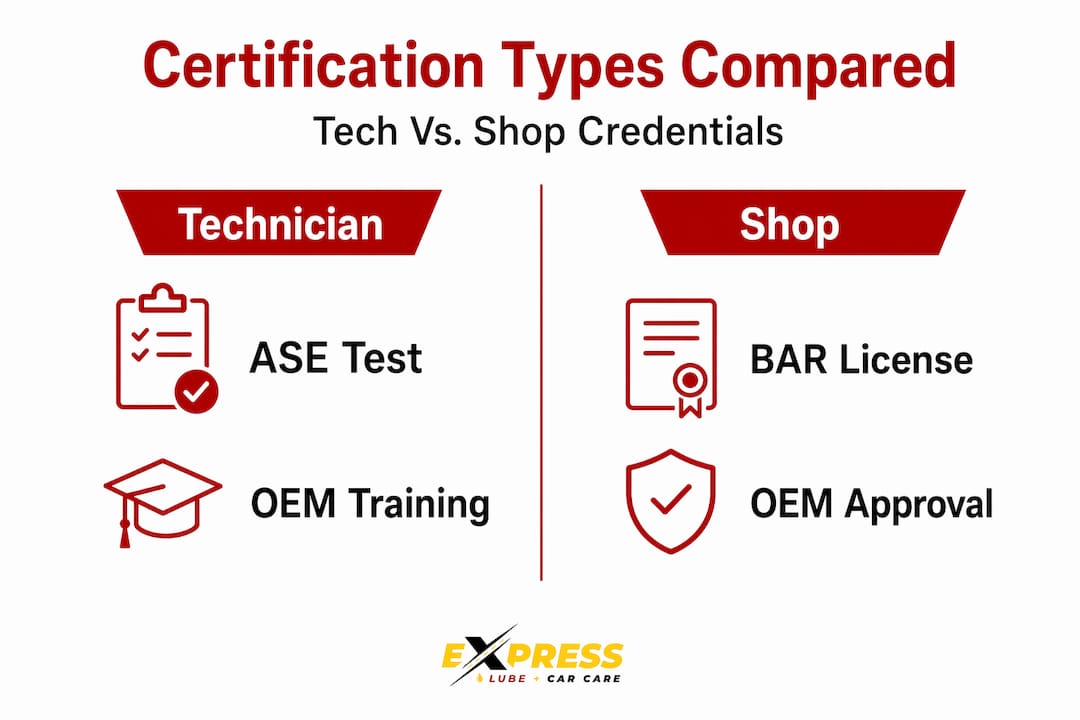
At the shop level, things work differently. ASE certifies individuals, not entire shops. Shops earn collective recognition through separate programs, like OEM-linked networks or third-party certification programs. For example, OEM-linked shop certifications such as the Collision Performance Network go beyond a badge. They require shops to meet tooling standards, repair procedures, and training benchmarks, including performance reviews and process traceability.
There are also regulatory certifications managed by state agencies. In California, the Bureau of Automotive Repair (BAR) issues licenses that legally govern who can perform emissions inspections and related repairs. These are not optional. Here is a quick look at the main certification types:
- ASE Technician Certification: Voluntary, exam-based, covers specific vehicle systems, earned by individual technicians
- OEM/Third-Party Shop Certifications: Earned at the shop level, include tooling requirements, standardized repair procedures, and ongoing performance oversight
- State Regulatory Licenses: Legally required in specific states; in California, certain repairs require ASE credentials A6, A8, and L1
- Specialty Credentials: Cover niche areas like hybrid systems, alignment, or advanced diagnostics
Each type tells you something different. Together, they form the foundation of what the importance of shop certification is really about.
Why certifications matter to you as a car owner
Think of certifications as a filter. They don’t guarantee perfection, but they do screen out a lot of guesswork. Here is what the benefits of mechanic certification look like in practice.
Trained technicians make fewer costly mistakes. When a technician has passed standardized ASE testing, they have demonstrated knowledge in a specific area, not just logged hours. That matters when your transmission, brakes, or electrical system is on the line. Shops that maintain certified staff tend to have lower “comeback” rates, which is industry shorthand for repairs that fail and require a return visit.
Regulatory certifications are tied to legal compliance. In California, smog repair technicians must hold current ASE certifications and renew their licenses every two years, including proof of recent update training. If your shop performs an emissions inspection without valid credentials, you could face issues with registration or legal compliance. This is not a corner case. It affects millions of drivers in regulated states.
OEM certifications protect modern vehicle repair integrity. Today’s vehicles are more software-driven and structurally complex than ever. Third-party OEM certification programs reflect operational quality standards covering tooling, training, and repair benchmarking. That means a shop in such a network follows specific repair procedures designed by the manufacturer, which is especially critical for collision or structural repairs where doing it wrong creates safety risks.
Pro Tip: Before authorizing any major repair, ask the shop which specific technician will be working on your car and whether that person holds current ASE certification in the relevant system. This one question will immediately reveal how seriously a shop takes its credentials.
Here is why this matters beyond peace of mind:
- Certified technicians are less likely to misdiagnose problems, saving you money on unnecessary parts
- Shops with active OEM certifications use manufacturer-approved procedures, protecting your warranty coverage
- State-licensed shops performing regulated services are legally accountable through their licensing body
- Reputable certification programs require documented proof of ongoing training, not just a one-time credential
How to verify a shop’s certifications before you commit
Knowing certifications exist is one thing. Knowing how to check them is what actually protects you. Here is a practical approach:
-
Ask for the technician’s credentials directly. Do not just ask if the shop is “certified.” Ask which technicians are ASE certified and in what specific areas. A shop with five technicians where only one holds an ASE credential is very different from a shop where the majority do.
-
Check ASE’s official verification tools. ASE maintains a public search tool at asecert.org that lets you verify a shop’s or technician’s certification status by zip code or business name. Use it. A quick two-minute search can confirm whether the credentials are current or expired.
-
Look for OEM or third-party network listings. If you drive a specific make, check whether the manufacturer maintains a certified shop locator. Many do. Similarly, RepairPal maintains a network of shops that meet independent quality standards, including technician training requirements.
-
Ask about renewal dates. Certification renewal cadence directly affects whether a shop is currently qualified to perform specialized services. A certificate from 2019 that was never renewed is not an active credential. It is a wall decoration.
-
Check state licensing databases for regulated services. If you need an emissions test or smog repair, verify the shop’s license status with your state’s regulatory body. In California, the BAR provides an online license verification tool. Other states have similar resources.
Pro Tip: Technicians must register by specific deadlines to take ASE certification exams, with testing available at over 450 centers across the country. If a shop claims its team is in the process of recertifying, ask for a timeline. Shops that take recertification seriously will have a clear answer.
If you want to understand what full-service, certified shops look like in practice, the benefits of full-service shops breakdown covers how certifications connect to broader service quality.
Certification types compared: what each one actually covers
Here is a side-by-side look at the major certification types and what they mean for repair quality:
| Certification type | Who it certifies | What it covers | Renewal required | Practical meaning for you |
|---|---|---|---|---|
| ASE Technician | Individual technician | Specific vehicle systems (A1-A9, L1, etc.) | Yes, every 5 years | Proven knowledge in a defined repair area |
| California BAR License | Individual technician or shop | Smog inspection and repair | Yes, every 2 years | Legally authorized to perform regulated services |
| OEM Network Certification | Entire shop | Tooling, procedures, training, benchmarking | Ongoing compliance | Manufacturer-standard repairs with accountability |
| RepairPal Certified | Entire shop | Pricing fairness, technician training, reviews | Ongoing compliance | Independent quality verification for car owners |
| Specialty Credentials | Individual technician | Hybrids, ADAS, alignment, etc. | Varies | Relevant for advanced or emerging vehicle systems |
This kind of comparison matters because the role of automotive certification is not one-size-fits-all. You want the right credential for the right service. An ASE A8 (engine performance) certification is meaningful for a tune-up but tells you nothing about whether that technician knows how to handle your hybrid battery system.
Misconceptions that can cost you money
Not everything a shop claims about certifications should be taken at face value. These are the most common misunderstandings:
- “Certified shop” does not mean all technicians are certified. A shop can earn a collective certification while individual staff members hold varying levels of credentials. Always ask who specifically will work on your vehicle.
- A framed certificate is not proof of current status. Certifications expire. An outdated credential displayed on a wall may be years past its renewal date and no longer valid.
- Not all certifications cover your specific repair. An ASE-certified technician who specializes in brakes may not be the right person for your transmission. Certifications are system-specific.
- Logos can be misleading. Some shops display certification logos on their signage or websites without actively maintaining the standards required to use them. Verification protects you from this.
- Certifications are not a substitute for shop reputation. They are one data point among several. Customer reviews, warranty policies, and repair estimates all add context that certifications alone cannot provide.
The auto repair industry, like many skilled trades, has its share of shortcuts. Understanding what certifications actually cover, and verifying them yourself, is the most direct way to avoid becoming a cautionary tale.
My honest take on certifications after years in the shop
I’ve worked alongside certified and non-certified technicians, and I’ll tell you straight: the certification itself is not magic. What it signals is discipline. A technician who keeps their ASE credentials current is telling you something about how seriously they approach their craft. They studied. They passed a test. They came back and did it again when the renewal came up.
What I’ve found most telling is not whether a shop has a certification, but whether they can explain what it covers. When someone on the service team can walk you through which of their techs holds which ASE designations and why that matters for your specific repair, that is a shop worth trusting. When they wave at a logo on the wall and move on, that is a reason to ask more questions.
The thing most car owners miss is that OEM network certifications are not just about marketing. Internal shop certification systems include repair process traceability, diagnostic workflows, and operational coaching. That is quality control built into how work gets done, not just who does it. I’ve seen shops with impressive credentials produce sloppy work because no one enforced the process standards. And I’ve seen the opposite: shops where certification requirements drove genuine improvement in how technicians approached every job.
My recommendation: treat certifications as your starting point, not your finish line. Verify them. Ask about renewal dates. Match the credential to the service you need. And then trust your gut about how the shop communicates.
— Hassan
Why certified service at Expresslubearlington makes a difference
At Expresslubearlington, we understand that handing over your car keys is an act of trust. That’s exactly why our team holds ASE credentials and RepairPal certification, so you know the people working on your vehicle have earned their credentials through testing and ongoing training, not just experience alone. Our technicians stay current with recertification cycles because we know that expired credentials are not real credentials.
We also back our work with recognition from CarFax as a Top-Rated Service Center, which reflects a commitment to quality that goes beyond any single certification. Whether you need routine maintenance or a more involved repair, you can save $45 on mechanical repairs and experience what certified service actually feels like. Come see us at our Arlington location and let our credentials speak for themselves.
FAQ
What does mechanic shop certification mean?
Mechanic shop certification refers to credentials held either by individual technicians (such as ASE) or by the shop as a whole (through OEM networks or programs like RepairPal). These credentials verify training, testing, and quality standards that affect the reliability of your repair.
Is ASE certification required by law?
In most states, ASE certification is voluntary. However, in California, specific ASE credentials are legally required for certain licenses, including smog repair technician licensing through the Bureau of Automotive Repair.
How often do mechanic certifications need to be renewed?
It depends on the type. ASE technician certifications require renewal every five years. California BAR smog repair licenses must be renewed every two years and include proof of recent update training.
Can I verify a mechanic’s ASE certification myself?
Yes. ASE provides an online search tool at asecert.org where you can look up certified shops and technicians by location. It is one of the fastest ways to confirm whether credentials are current before you schedule a repair.
Does a certified shop guarantee quality repairs?
Certification reduces the risk of errors and reflects real standards, but it is not an absolute guarantee. Verifying which technician will work on your car, confirming certifications match your specific repair, and checking renewal dates all give you a more complete picture of service quality.